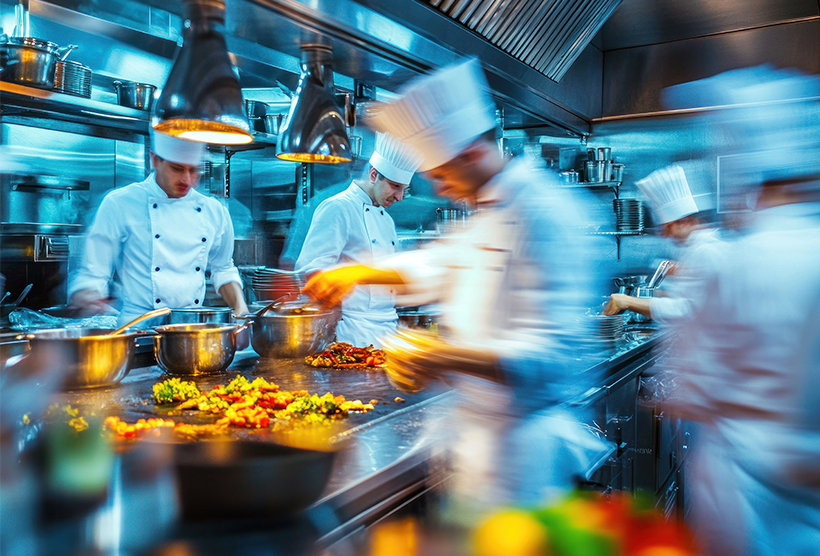
In foodservice, the pressure to respond quickly is constant.
New ideas emerge, customer preferences shift, competitors evolve, and the industry moves at pace. The instinct to react is understandable. Staying relevant often feels like staying responsive.
But speed, on its own, is not always an advantage.
And in many cases, reacting too quickly can introduce more risk than it removes.
When responsiveness becomes reaction
There is a difference between being informed and being reactive.
Informed decisions are considered. They take into account not just what is changing, but how those changes will work in practice. They balance opportunity with operational reality.
Reactive decisions, by contrast, are often driven by urgency. A trend is adopted quickly. A product is introduced without full consideration. A menu is adjusted before the impact is fully understood.
The intention is to stay ahead.
The result can be something very different.
The hidden costs of moving too fast
At first, the impact of a quick decision can be difficult to see.
A new product line is added.
A menu item is introduced.
A supplier is changed.
Individually, these shifts feel manageable.
But over time, they begin to create friction.
Additional products increase complexity in ordering and storage.
New ingredients introduce variability in preparation.
Unfamiliar formats require training and adjustment.
And because these decisions are made quickly, they are often layered on top of existing systems, rather than integrated into them.
What begins as a response to change can gradually become a source of instability.
Pressure without performance
One of the most common outcomes of reacting too quickly is increased pressure without improved performance.
Teams are asked to adapt to new products or processes without the time to embed them properly. Service becomes less predictable. Consistency starts to vary.
And the intended benefit, whether it is differentiation, efficiency or margin improvement, is not always realised.
In some cases, it is reversed.
The challenge of stepping back
Once changes are made, they are not always easy to undo.
Products remain in the range.
Menu items continue to appear.
Processes become embedded, even if they are not optimal.
Over time, this creates a system that has evolved quickly, but not always effectively.
Stepping back to reassess can feel like losing momentum, even when it is the right decision.
A more measured approach
The operators performing best are not necessarily the fastest to react.
They are the ones who take a more measured approach.
They observe patterns, not just moments.
They test ideas before fully committing.
They consider how changes will perform under real service conditions.
And importantly, they prioritise changes that can be sustained, not just introduced.
This does not mean standing still. It means moving with intention.
Building for what lasts
In a fast-moving industry, there is always pressure to do more, add more, change more.
But long-term performance is rarely built on constant reaction.
It is built on decisions that hold up over time.
That means selecting products that integrate easily into existing systems. Choosing formats that support consistency. Introducing changes that improve performance, not just perception.
Because the real cost of reacting too quickly is not the decision itself.
It is everything that follows.
In a changing market, it is not just about responding quickly, but responding well.
Our focus is on products that deliver consistent performance and integrate smoothly into real kitchen environments, helping operators adapt with confidence, not compromise.